Payment delays have become an all-too-familiar challenge. Internal constraints and competing priorities often push overdue invoices down the list, allowing backlogs to grow and issues to persist.
Economic shocks such as rising interest rates and persistent inflation have increased pressure on businesses, compounding earlier disruptions such as higher operating costs and supply chain instability. As a result, cash reserves have thinned over time, reducing the flexibility that businesses once had to absorb delays. With this reduced buffer, even short waits for payment can influence how organisations plan and manage their operations, particularly when outgoings can’t easily be adjusted.
The Growing Impact of Late Payments on UK Businesses
Late payments have long created difficulties for businesses and recent evidence shows the situation has become severe. Research commissioned by the Office of the Small Business Commissioner estimates that late payments cost the UK economy almost £11 billion each year with around 14,000 businesses closing annually as a result. Many of these closures occur when companies lack the cashflow needed to continue operating while they wait for overdue invoices to be settled.
For a growing number of organisations, delays can influence day-to-day decisions in ways that restrict progress, such as postponing hiring or delaying planned projects. Supplier relationships can become strained and investment plans are often scaled back. These pressures are felt most by businesses with limited financial flexibility, since even a single unpaid invoice can disrupt essential operations.
Why Payment Delays Are Increasing Across Key Sectors
Recent trends show businesses in several key sectors are extending payment times, often well beyond agreed terms. Manufacturing, transport and storage, wholesale and retail, and administrative services have been identified in multiple industry reports as some of the slowest-paying sectors. Pressure on cashflow is a major factor behind this pattern, with rising operating costs making customers more cautious about releasing funds. Many firms are now prioritising their own financial position before paying suppliers which slows the movement of money across supply chains that depend on predictable payment cycles.
Industry data from Novuna Business highlights this clearly, with the transport and storage sector showing average payment delays of around 62 days, significantly beyond standard 30-day terms. Payment delays pose a particular challenge for operators who rely on steady income to maintain storage facilities and keep scheduled work on track, since even short gaps in cashflow can influence how planning and service delivery unfold.
The effect of delayed payment became clear when a global storage solutions company approached us after one of their invoices fell into arrears. Their work depends on steady cashflow to keep container movements on schedule and maintain storage capacity across multiple locations, so even a short disruption created immediate pressure. Early contact allowed the situation to move forward quickly, although the debtor disputed the applied fees and claimed payment had already been made prior to us getting involved By reviewing the original invoice details alongside the payment timeline, our expertise in managing payment disputes facilitated constructive dialogue between both parties, clarifying liability and leading to the outstanding balance being settled within 8 days.
Keeping Momentum When Invoices Begin to Stall
If chasing overdue invoices comes to a halt and further action is postponed, the chance of recovery begins to fall. As time passes, details surrounding the original transaction can be harder to confirm, creating room for uncertainty or disagreement. This loss of clarity interrupts progress and turns what began as a straightforward delay into a more demanding task, leading to backlogs.
Support from a trusted partner can help prevent this drift when case progression starts to fade. By restoring clarity around the invoice and re-establishing focus on resolution, the risk of overdue invoices stalling or becoming prolonged issues that disrupt wider plans is reduced.
Redwood Collections and the Path to Resolution
We work with businesses across a range of industries who deal with growing backlogs of overdue invoices. Time pressures and internal constraints often mean there’s no clear process in place to manage these delays effectively.
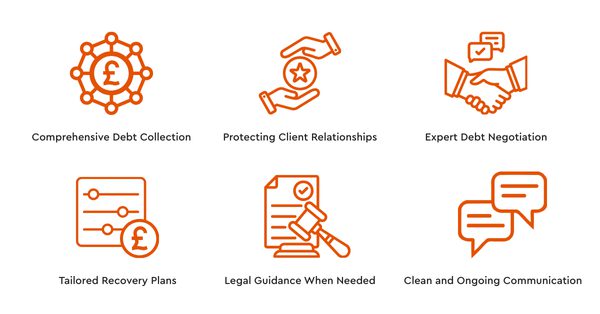
The elements shown below outline how our Collections service helps keep overdue accounts moving and prevents cases from losing momentum. Where non-payment continues or details remain unclear, our approach supports progress and reduces the risk of delays becoming prolonged.
Partnering with Redwood Collections can help restore control at a time when payment behaviour is becoming increasingly difficult to predict, offering a structured way to address overdue invoices before delays become accepted as routine.
For further guidance on how we could support your business this year, contact us on 020 8080 2888 or fill out our online contact form.